

Reviewed · LITTLE MERMAID & LANDMARKS
Copenhagen: Amalienborg Palace Museum Entry Ticket
Amalienborg Museum puts you close to the Danish monarchy without the distance and ceremony of a formal state visit. Inside Christian VIII’s Palace, you move through private rooms, studies, dining spaces, jewelry displays, and the grand Gala Hall, seeing how royal life looked over the past 150 years.
I like the preserved interiors, especially Christian X’s study and the dining room he shared with Queen Alexandrine. I also like the museum’s family appeal: a child-friendly audio guide helps younger visitors follow the story, and the route is easy to manage in roughly 45 minutes to an hour.
The main drawback is scale. At $19 per person, the museum is not a full-day attraction, and some people may find there is not enough to see for the price. Still, the setting on Amalienborg Square and access to every exhibition make it a useful stop if you want a close look at Denmark’s royal family.
Key points to know before entering
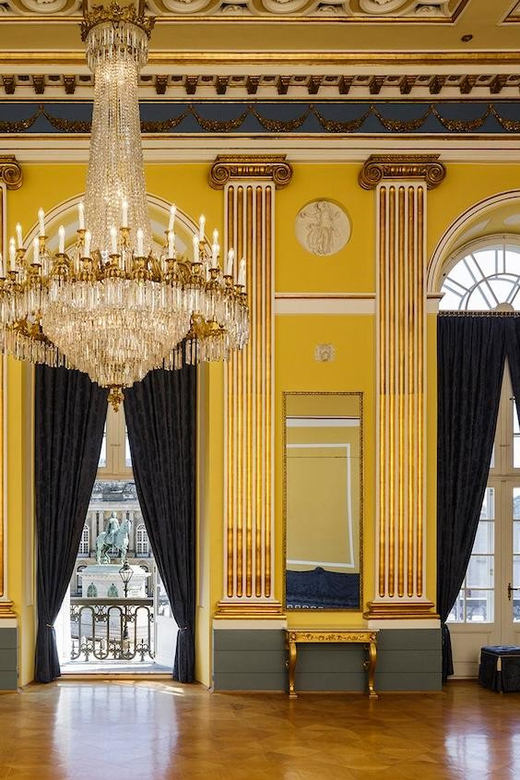
- Royal rooms preserved in place: See Christian X’s study, Queen Louise’s private salon, and a dining room kept almost as it looked during their time at Amalienborg.
- The Fabergé Chamber: Examine Russian jewelry made from 1860 to 1917, including a coronation brooch created for Tsar Nicholas II.
- The Gala Hall: Look up at an eight-meter ceiling, gilded decoration, and sculptures by Bertel Thorvaldsen.
- A short, self-guided visit: Plan on about 45 minutes to one hour inside, with extra time for the palace square.
- Ticket exchange required: Present and scan your online ticket at the downstairs cashier before going upstairs.
- Travel light: Large bags, backpacks, oversized luggage, food, drinks, and baby strollers are not allowed inside.
Amalienborg Square and the palace setting
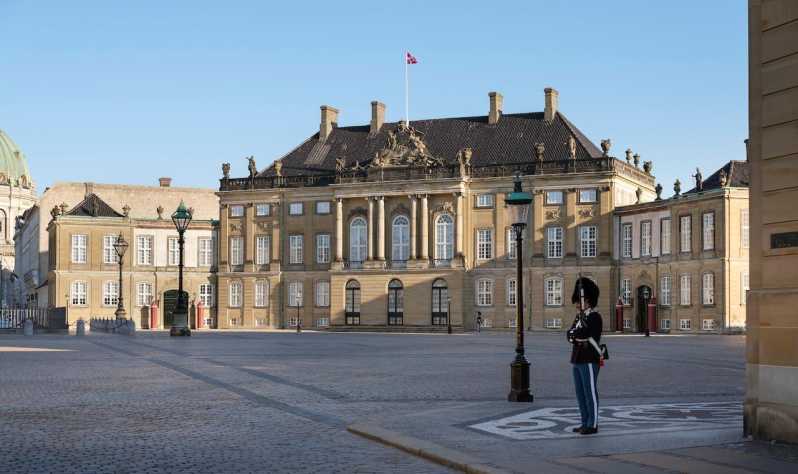
Amalienborg is not one single palace building. The complex is made up of four palaces arranged around a broad central square, and the museum occupies Christian VIII’s Palace.
The museum entrance is in the first building on your left when you enter the square from Frederiksgade or from the direction of the Marble Church. This detail matters because the matching palace façades can make the entrance easy to miss. Look for the museum in that first building rather than assuming the main entrance is somewhere across the square.
Your ticket is valid for one day, but the visit itself is not built around a fixed guided group. Before going upstairs, you need to go downstairs to the cashier, where the online ticket is presented and scanned. Allow a few extra minutes for this step, especially if you arrive close to your planned time.
The palace square is part of the appeal. You can spend a little time looking at the four matching buildings before or after the museum, and the open space gives you a sense of how the royal complex fits into central Copenhagen. The museum itself is the ticketed part of the experience.
More landmark stops in Copenhagen:
- Copenhagen Little Mermaid Exploration Game and Self-Guided Tour
★ 4.0 · 36 reviews - Grand Tour of Copenhagen – The Little Mermaid to Royal Castle
★ 5.0 · 8 reviews - Copenhagen Self-Guided Murder Mystery Tour by Amalienborg Palace
★ 4.0 · 3 reviews
Christian VIII’s Palace and the museum route
The route takes you through rooms connected with the Danish royal family across roughly 150 years. This is not simply a display of paintings and labels. The rooms remain furnished, so you get a sense of daily routines, family connections, taste, and status.
I find this approach more personal than a museum made up only of objects in glass cases. A desk still arranged as a working study tells you something different from a portrait on a wall. Tables, photographs, furniture, and decorative details help you connect people to the building.
The path is well planned, so you can follow the museum without much guesswork. The visit is self-guided, and an audio guide is available, including material suited to children. That makes the museum easier to share with a seven-year-old or another young visitor who may not want a long lesson in royal genealogy.
You should allow 45 minutes to one hour inside. If you read every label carefully, listen to the audio material, and pause for the rooms, you may need longer. If you prefer a quick look at the highlights, the museum can be shorter. There is no guided tour included, so you set the pace.
Christian X’s study and the royal family’s private side
Christian X’s study is one of the strongest rooms in the museum because it feels like a working space rather than a ceremonial set. It has dark walls and heavy furniture, the sort of interior associated with a gentleman’s study around 1900.
The room also reflects Christian X’s background as an officer. That detail gives the furnishings a clear purpose. You are not just looking at expensive objects. You are seeing a room shaped by the habits and identity of the person who used it.
The study was preserved as it appeared from Christian X’s arrival at the palace in 1899 until his death in 1947. This long period gives the room a particular weight. It connects the setting to a single royal life rather than presenting an anonymous version of palace style.
For me, this is where the museum works best. The royal family can seem distant when you see only formal portraits and grand ceremonies. A personal study narrows that distance. It shows how one monarch worked, lived, and arranged his surroundings.
Nearby, Christian X and Queen Alexandrine’s dining room offers another view of family life. The room appears almost as it did during their years at Amalienborg, from 1899 until Christian X’s death in 1947 and Queen Alexandrine’s death in 1952.
The dining room is worth taking slowly. Its importance is not just decoration. It helps you picture the palace as a home where meals, family events, and ordinary routines took place. If you are mainly interested in architecture, you may move through it quickly. If you like social history, this is one of the better stops.
Queen Louise’s salon and European family ties
Queen Louise’s private salon dates from around 1895 and shows a more modern interior style for its time. Compared with Christian X’s darker study, the room gives you a different sense of royal taste.
The paintings and framed photographs on the tables are especially useful. They point to Queen Louise’s family life and her close connections across Europe. The room is personal without being cluttered, and the photographs help explain that royal marriages were also links between ruling families.
This is a good place to use the audio guide if you want more context. The room’s meaning comes from the people connected to it, not just from its furniture. Without that context, it could seem like another attractive palace interior. With it, the photographs become evidence of a large family network.
The museum’s strongest rooms work in this way. They let you move from decoration to people, then from people to Danish and European history. That makes the visit suitable for adults who want context, while the preserved settings give younger visitors something concrete to look at.
More museums in Copenhagen:
- Copenhagen: National Museum of Denmark Entry Ticket
★ 4.5 · 960 reviews - Exhibition – Home of Carlsberg
★ 4.5 · 281 reviews - Copenhagen: Danish War Museum Entry Ticket
★ 4.7 · 106 reviews - Copenhagen: MACA Art Museum Entry Ticket
★ 4.7 · 77 reviews
The Fabergé Chamber and Russian royal connections
The Fabergé Chamber changes the mood of the visit. Here you see hand-crafted Russian jewelry made between 1860 and 1917, with attention to the close ties between the Danish and Russian monarchies.
The collection includes the Fabergé coronation brooch made for the coronation of Tsar Nicholas II. A piece like this gives the museum a wider reach. Amalienborg is not only about Danish kings and queens. It also shows how royal families were linked through marriage, ceremony, gift-giving, and political relationships.
Jewelry can be easy to rush past, particularly after several furnished rooms. Give this chamber a little time. The craftsmanship is one reason to visit, but the connection to the Russian monarchy is just as important.
If you are bringing children, this may be a good stop to pair with the audio guide. Small objects need explanation, while the royal rooms are easier to understand at a glance. The combination keeps the museum from feeling like a series of quiet rooms with no clear story.
The Gala Hall and the grandest interior
The Gala Hall is the museum’s big visual finish. With an eight-meter-high ceiling, lavish gilding, and a view toward the palace square, it is among the most impressive rooms in Denmark.
The room was commissioned by the Royal Family in 1794, when artist Nicolai Abildgaard was asked to design the interior. Sculptor Bertel Thorvaldsen created the sculptures. The hall gives you the ceremonial side of monarchy after the more intimate studies, salons, and dining rooms.
Look up before moving on. The height and decoration are easy to miss if you focus only on objects at eye level. The view toward the square also helps you understand the relationship between the palace interior and the public face of the monarchy outside.
The Gala Hall alone will not make this a full-day attraction, but it gives the visit a strong sense of scale. You see the contrast between a king’s dark study and a room designed to impress a crowd. That contrast is one of the museum’s best features.
The Frederik X exhibition and changing displays
The special exhibition Frederik X: King of Tomorrow ran from March 22 through September 8, 2024. It marked the succession of the Danish throne on January 14 and presented a portrait of the new king through photographs, objects, video clips, paintings, and sound.
If you are visiting after September 8, 2024, do not assume this exhibition is still on view. The museum’s permanent rooms remain the dependable reason to go, while temporary displays change over time.
The exhibition format gives you an example of how Amalienborg can connect the monarchy’s past with its present. The permanent rooms show earlier generations through their belongings and interiors. A temporary display can use video, sound, and recent images to explain a living institution.
Since your ticket includes all exhibitions available during your visit, it is worth checking the current display before booking. The special exhibition may affect the value for you, especially if you have a strong interest in the current Danish monarchy.
How long the visit takes and what the $19 price means
The ticket costs $19 per person. That is reasonable if you value well-preserved royal interiors, but it can feel high if you expect hours of entertainment or a guided palace tour.
I would budget one hour inside, then add time outside on Amalienborg Square. The museum itself is compact enough to fit into a central Copenhagen sightseeing day. It works well between other stops rather than as the sole plan for an afternoon.
The value improves if you use the audio guide and take time with the rooms. The route is not packed with a large number of exhibits, so the experience depends on how much attention you give to the furnishings, portraits, photographs, and royal connections.
There is no guided tour included. That keeps the visit flexible, but it also means you will need to follow the labels or audio material yourself. If you want a guide explaining every room in person, this ticket is not that product.
The ticket includes entry to the Amalienborg Palace Museum and access to all exhibitions. It does not include food, drinks, transport, or a guided tour. For a short visit in central Copenhagen, I see it as a fair purchase for people interested in royal homes and interiors, but a less convincing choice for anyone counting on a large, activity-filled attraction.
Practical details that can shape your visit
Pack lightly. Large bags, large purses, backpacks, oversized luggage, food, drinks, and baby strollers are not allowed inside. Pets are also not allowed, although assistance dogs are permitted.
Wheelchair access is available. If you need a fully detailed accessibility plan, confirm the current arrangements before arrival, since the information provided only confirms wheelchair accessibility.
Do not arrive more than 20 minutes late. After that point, the ticket is no longer valid. Since you must first present and scan the online ticket downstairs, arriving a little early is the sensible choice.
The ticket can be canceled up to 24 hours in advance for a full refund. You can also reserve now and pay later, which is useful if your Copenhagen schedule is still shifting. The ticket is valid for one day, with starting times shown when you check availability.
Who should book Amalienborg Museum?
I would book this museum if you like royal history told through real rooms and personal objects. It is particularly suitable for families, since the child-friendly audio material gives younger visitors a way into the story.
It also fits well into a walking day in central Copenhagen. The palace square is easy to combine with nearby sights, and the indoor visit lasts less than an hour for many people.
I would hesitate if you want a long guided tour, a large collection, or a full afternoon of entertainment. At $19, the museum asks you to care about the details. If that sounds like your kind of sightseeing, the preserved study, salon, dining room, Fabergé jewelry, and Gala Hall make it a worthwhile stop.
FAQ
Where is the Amalienborg Museum located?
The museum is in Christian VIII’s Palace, one of the four palaces that make up Amalienborg in Copenhagen. Enter Amalienborg Square from Frederiksgade or the Marble Church, and use the first building on your left.
How much does admission cost?
The entry ticket costs $19 per person.
How long is the ticket valid?
The ticket is valid for one day. Check availability for the starting times offered when you book.
Does the ticket include a guided tour?
No. The ticket includes entry to the Amalienborg Palace Museum and access to all exhibitions, but no guided tour.
Do I need to exchange my online ticket?
Yes. Before going upstairs to the exhibition, go downstairs to the cashier and present and scan your online ticket.
What happens if I arrive late?
Your ticket is no longer valid if you arrive more than 20 minutes late.
Can I bring a large bag or baby stroller?
No. Large bags, large purses, backpacks, oversized luggage, and baby strollers are not allowed inside. Food and drinks are also prohibited.
Is the museum wheelchair accessible?
Yes, the activity information confirms that the museum is wheelchair accessible.
Just added around Copenhagen
- Copenhagen: Express Walk with a Local in 60 minutes★ 4.6 · 3 reviews
- Copenhagen: 3 Hour Extended Grand E-Bike Guided Tour★ 4.6 · 3 reviews
- The Forgotten Giants Private Tour★ 5.0 · 3 reviews
- Castles of Kronborg and Frederiksborg from Copenhagen by Car★ 4.5 · 3 reviews
- Departure by Luxury Vehicule Copenhagen to Copenhagen airport CPH★ 5.0 · 3 reviews
- Copenhagen: Self Guided Scavenger Hunt and Tour★ 4.0 · 3 reviews
- Private Transfer Copenhagen Airport CPH to Copenhagen by Sedan★ 4.5 · 3 reviews
- Copenhagen Craft BeerWalk City Center★ 4.4 · 3 reviews
Little Mermaid & Landmarks, compared.

Copenhagen Little Mermaid Exploration Game and Self-Guided Tour
Read our review →
Grand Tour of Copenhagen – The Little Mermaid to Royal Castle
Read our review →
Copenhagen Self-Guided Murder Mystery Tour by Amalienborg Palace
Read our review →Browse the lists this tour appears in