
Reviewed · LITTLE MERMAID & LANDMARKS
Grand Tour of Copenhagen – The Little Mermaid to Royal Castle
Copenhagen’s royal center, harborfront, and best-known sights fit into one busy morning on this guided tour. You’ll see the Little Mermaid, pause for the changing of the guard at Amalienborg, pass Rosenborg and Christiansborg, and finish back at the central meeting point. It is a useful first look at a city whose sights are spread across several districts.
I like the wide sweep of the route and the chance to see places such as the Gefion Fountain, Black Diamond, Børsen, and Christianshavn without arranging several separate journeys. I also like the transport, onboard WiFi, audio guide, and host-driver, especially if you have only a few hours before a cruise. The tradeoff is clear: this is a sightseeing overview, not an inside visit to the palaces, museums, or Tivoli Gardens.
Key points to know
- The Little Mermaid opens the tour with a five-minute photo stop beside Copenhagen’s most famous statue.
- Amalienborg includes the daily noon guard change, an especially useful detail when the schedule lines up.
- The route covers royal Copenhagen and the harbor districts, including Nyhavn, Christianshavn, Børsen, and the Black Diamond.
- A vehicle handles the long distances, with air conditioning, WiFi, and an audio guide included.
- The group can reach 33 people, so expect a shared tour rather than a private city walk.
- The $61.40 price buys breadth and convenience, but not admission to the attractions along the way.
A fast introduction to Copenhagen’s royal sights
This tour is built for orientation. Over about two and a half hours, and sometimes as long as three, you move through the city’s major landmarks by vehicle, with brief stops at selected points. You get the broad picture: royal power around Amalienborg and Christiansborg, maritime Copenhagen around Nyhavn and Christianshavn, and the city’s most photographed public monuments.
The route begins at Banegårdspladsen 2, beside Copenhagen’s central station area, at 9:30 a.m. Pickup is offered, and the tour ends back at the meeting point, though arrangements should be checked carefully if you expect hotel or cruise-port pickup. The vehicle matters here. Copenhagen’s sights are not all clustered around one square, and moving between them saves your limited morning.
You are not signing up for a long museum visit. Most stops are outside, with a few minutes for a photograph and a short explanation. The audio guide helps fill in the gaps, while the host-driver provides live commentary. Past guides named in the tour feedback include Christian and Peter, though guide assignments can change.
More castle day trips from Copenhagen:
- Copenhagen: Kronborg, Frederiksborg Castle and Roskilde Tour
★ 4.9 · 1,763 reviews - Copenhagen: Rosenborg Castle Entry Ticket
★ 4.6 · 381 reviews - Full-Day; Castle, Palace, Cathedral & Viking ships Tour
★ 5.0 · 326 reviews
Tivoli, museums, and the green edge of the city
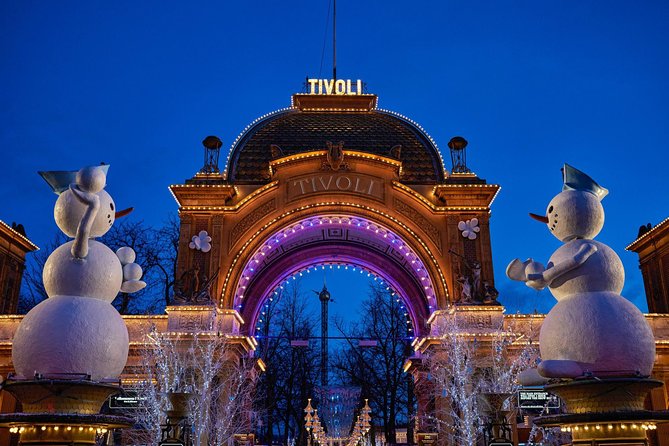
The route includes Tivoli Gardens, the amusement park that opened in 1843 under Georg Carstensen. Even from a short stop or drive-by, Tivoli gives you a sense of Copenhagen’s long love affair with gardens, entertainment, and public spaces.
The tour also passes an art museum with antique sculpture from the Mediterranean and French and Danish works from the 19th century. Another stop concerns the State Natural History Museum and its plant collection, spread across 10 hectares. The Palm House is one of the notable features, and the area also connects to the old Østervold Observatory, associated with the astronomer Tycho Brahe.
These sections add variety to a route that could otherwise focus only on palaces. You may see several of these places from the vehicle rather than enter them, so treat them as orientation points. If Tivoli, the Palm House, or a museum is high on your list, plan a separate visit.
Meeting the Little Mermaid by the harbor
The Little Mermaid is a short stop, listed at about five minutes, with free admission. She has sat on her granite rock since 1913, when Carl Jacobsen, founder of the Carlsberg Brewery, gave the statue to Copenhagen. Edvard Eriksen modeled her in bronze after Hans Christian Andersen’s tale of a mermaid who loves a human prince who does not return her love.
The statue itself is small. That surprises many people who expect a grand monument, but her modest size is part of the charm. The rock is accessible at low tide, though you should not count on climbing out for a better angle during a short organized stop.
You’ll also hear about the statue’s rough treatment over the years. She has been beheaded twice, lost an arm, and been covered in red paint. The political message Free Hong Kong was also painted on her. Those incidents are a reminder that this little figure carries far more public attention than her size suggests.
This is one of the tour’s more practical photo stops. You get a classic Copenhagen image without spending time working out transport to the waterfront. The drawback is the short time limit. If you want a quiet look at the harbor or a careful set of photographs, you will probably want to return independently.
Resistance history and the Gefion Fountain
Near the waterfront, the tour includes the Danish Resistance Museum. The museum is housed underground in a building opened in 2020, after the former building burned in 2013. Most of the collection survived, and the museum explains daily life during the German occupation from 1940 to 1945, with special attention to Danish resistance groups.
The museum is a meaningful stop because it puts Copenhagen’s calm streets into a harder 20th-century context. Still, the itinerary does not indicate a museum admission or a full indoor visit. You should view this as a landmark and introduction unless the guide confirms time to go inside.
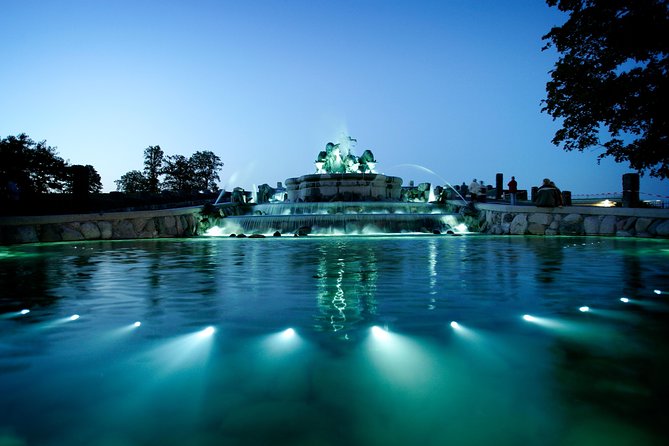
The Gefion Fountain makes a good outdoor counterpoint. It shows the goddess Gefion turning her sons into oxen and plowing the island of Zealand from Swedish soil. Carlsberg’s foundation paid for the fountain, which Anders Bundgaard sculpted between 1897 and 1899. The basin was completed in 1908, the year the fountain first operated.
This stop gives you a bit of Danish legend, sculpture, and national identity in one place. It is also close to the waterfront sights, making the route feel connected rather than like a random checklist.
More landmark stops in Copenhagen:
- Copenhagen: Amalienborg Palace Museum Entry Ticket
★ 4.3 · 291 reviews - Copenhagen Little Mermaid Exploration Game and Self-Guided Tour
★ 4.0 · 36 reviews - Copenhagen Self-Guided Murder Mystery Tour by Amalienborg Palace
★ 4.0 · 3 reviews
The noon guard change at Amalienborg
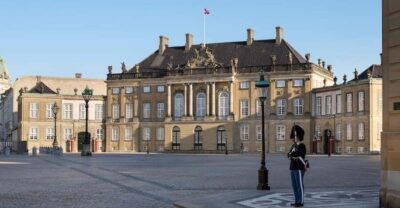
Amalienborg is one of the tour’s strongest timed stops. The four palaces date from the 1760s, and the royal family moved here in 1794 after Christiansborg burned. The complex includes Christian VII’s Palace, Christian VIII’s Palace, Frederik VIII’s Palace, and Christian IX’s Palace.
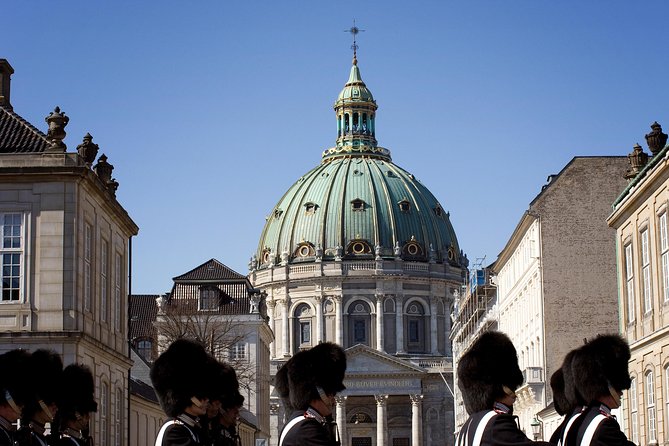
The daily changing of the guard takes place at noon. This tour starts at 9:30 a.m., so the schedule may bring you into position at the right time, but you should confirm the exact timing on your date. The listed stop lasts about 20 minutes and has no admission charge.
Frederik VIII’s Palace is where King Frederik X and Queen Mary stay when they are in Copenhagen. That detail helps you understand Amalienborg as a working royal residence, not merely a historic monument. The open square also offers a strong view toward the Marble Church.
You will likely get more from this stop than from a simple drive past. The guard ceremony provides a bit of pageantry, while the square makes the scale of the royal complex easy to grasp. If you want palace interiors, royal objects, or a longer look at the rooms, you will need separate admission and time.
The Marble Church and Christiansborg
Frederik’s Church, usually called the Marble Church, began as a project for King Frederik V in 1740. Nicolai Eigtved designed it, but construction slowed after his death in 1754 and stopped in 1770. Ferdinand Meldahl later completed the building in the late 19th century, using limestone instead of marble to keep costs under control.
The dome is the church’s signature feature. It is described as the third-largest church dome in Europe, and it gives the area a strong visual anchor. You may see the church from outside during this tour, with limited time for more.
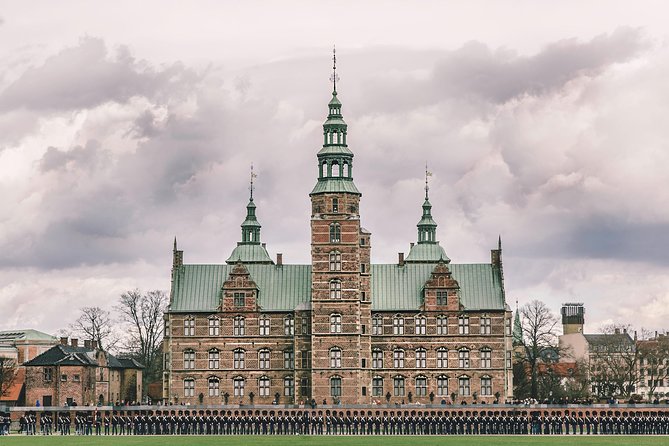
Christiansborg introduces another side of Denmark’s government. The Danish parliament, the Folketing, meets there, and the present building dates from 1928. Beneath it lie the ruins of Bishop Absalon’s first Copenhagen Castle, built in 1167.
The palace has been rebuilt more than once. The first Christiansborg was built by King Christian VI in 1740, while the church roof caught fire in 1992 and repairs finished in 1997. Christiansborg is also tied to modern royal ceremony. King Frederik X’s throne is there, and he waved from the balcony when Prime Minister Mette Frederiksen proclaimed him king. Denmark has no coronations.
That combination of medieval remains, parliament, palace rooms, and current royal life makes Christiansborg one of the most useful stops for understanding how old and new Denmark overlap. Again, this tour gives you the setting, not a palace tour.
Thorvaldsen, the Royal Theater, and the harbor view
The route passes the museum by the canal connected with Bertel Thorvaldsen, Denmark’s best-known neoclassical sculptor. The museum contains his work and his grave. It is an attractive place to note for a later visit if sculpture interests you.
A five-minute stop at Det Kongelige Teater and Operaen provides a chance to photograph Copenhagen Harbor and Amalienborg Palace. The view is one of the tour’s simple pleasures. You get water, modern cultural buildings, and royal architecture in one frame.
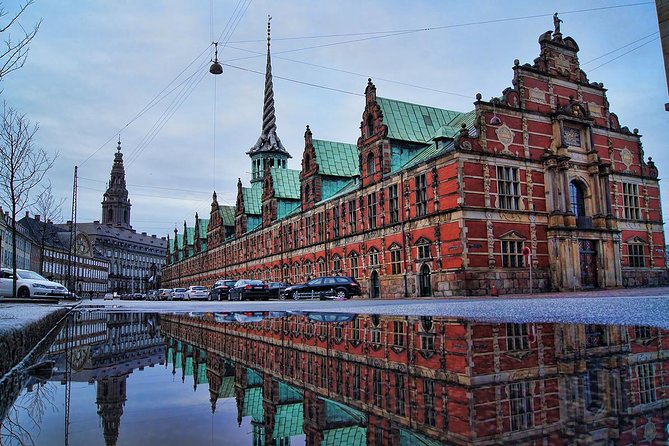
The itinerary also includes an equestrian statue of Bishop Absalon, the city’s founder, dating from 1902. Nearby, Børsen recalls Copenhagen’s trading past. King Christian IV built the old Stock Exchange in the 1620s, and it continued as a stock exchange into the 1800s. The upper floors once handled trade in physical goods.
Look up at Børsen’s famous spire, made of intertwined dragon tails. The building is now owned by Dansk Erhverv, one of Denmark’s large business and employer organizations. These details make the stop more than a quick photograph, even if you only see the exterior.
Christianshavn, canals, and the Black Diamond
Christianshavn gives you a change of mood. The tour pauses to overlook its canal and Our Saviour’s Church, an area known for water, old buildings, and a more local urban feel than the formal palace district.
The route also includes an 18th-century mansion with collections and exhibitions about Denmark’s people, culture, and past. It passes the Danish National Gallery, which holds international collections, temporary exhibitions, and children’s activities. These are useful pointers if you plan to stay in Copenhagen after the tour.
The Black Diamond is the modern architectural counterpoint. Built in 1999, it is an extension of the Royal Danish Library, designed by Schmidt, Hammer and Larsen in black granite from Zimbabwe. A bridge connects it to the original library building from 1906. Inside are a reading room, music room, café, and bookshop.
You may find the contrast between old canal streets and the Black Diamond especially helpful. Copenhagen’s identity is not only royal squares and painted harbor houses. It is also libraries, design, public institutions, and working neighborhoods.
Langebro and the colorful Nyhavn finale

Langebro is an opening bridge that lets large ships pass through the harbor. The present bridge dates from 1954 and was designed by Kaj Gottlob. It is 7 meters high and 35 meters long, and the city council owns it.
Its earlier history reaches back to a wooden bridge built in 1690 under King Christian V. Repairs began after rainwater damaged the concrete, with the work expected to cost 307 million kroner, or about €40 million. You probably will not stop long enough to study the engineering, but the bridge helps explain how Copenhagen balances traffic, canals, and shipping.
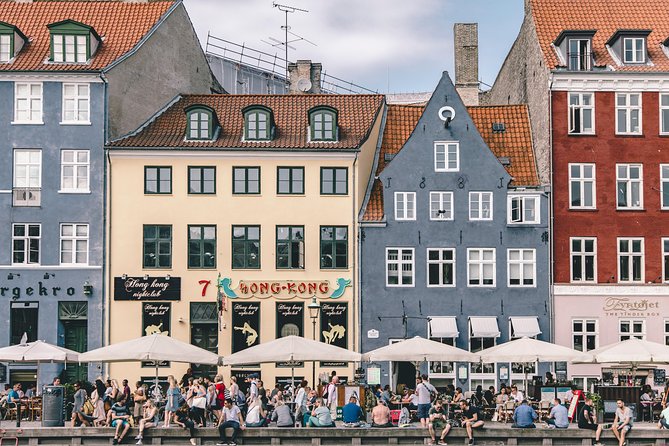
Nyhavn is the colorful final image many people associate with Copenhagen. The canal was built between 1671 and 1673 by Swedish prisoners of war. Nyhavn 9, the oldest house, dates to 1681. The area was rougher in the 1970s, then underwent renovation in the 1980s and became the restaurant and café strip you see today.
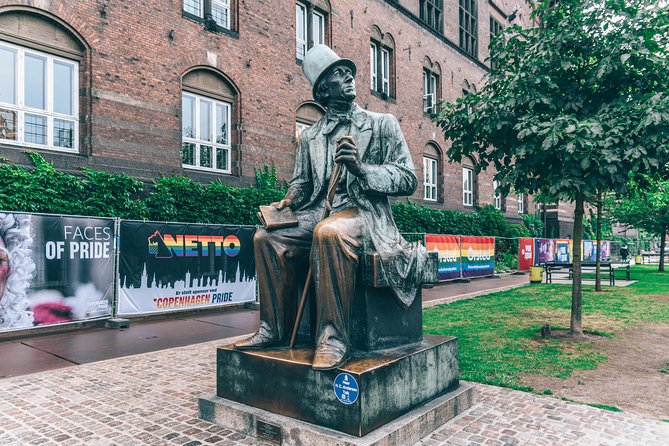
Hans Christian Andersen lived at several Nyhavn addresses, including numbers 18, 20, and 67. At the canal’s end, a memorial anchor honors Danish merchant sailors who died during the Second World War.
Nyhavn is photogenic, but it can feel commercial and crowded compared with Christianshavn. The benefit of visiting by tour is that you get the basic story and location, then can return later for a meal or a slower walk.
Is $61.40 a fair price?
At $61.40 per person, the value rests on convenience and coverage. You are paying for an air-conditioned vehicle, host-driver, WiFi, an audio guide, and a route that links distant sights in one morning. You are not paying for lunch or admission to the palaces, museums, Tivoli, or other indoor attractions.
I think the price makes the most sense in three situations:
- You have only a few hours in Copenhagen.
- You are connecting a hotel stay with a cruise departure and want to see more of the city on the way.
- You prefer a guided overview before choosing which sights deserve a longer visit.
The value is weaker if you already know Copenhagen well or want to spend most of your time inside one palace or museum. A group of up to 33 people also means you should expect a set pace and brief stops rather than the freedom of a private guide.
Who will get the most from this tour?
I would choose this for a first visit, a short stopover, or a cruise schedule. It is also useful for anyone who finds Copenhagen’s spread-out sights hard to organize. The vehicle keeps the morning moving, and the live host plus audio guide give you context while you travel.
Families may appreciate the short stops and the lack of a long indoor session, though the number of historical references can be a lot for young children. Art, architecture, royal history, and harbor scenery all appear, but none receives a full treatment.
If your priority is local food, free time, or quiet street wandering, this is not the ideal format. You will see Nyhavn and Christianshavn, but you will not have much time to linger. Treat the tour as your city map in motion, then return to the places that catch your interest.
Free cancellation is available up to 24 hours before the 9:30 a.m. start time. The tour requires a minimum number of participants, so a cancellation by the provider may result in another date or a full refund.
Should you book the Grand Tour of Copenhagen?
Book it if you want maximum city coverage in one short morning, especially before a cruise. The Little Mermaid, Amalienborg’s noon guard change, Christiansborg, Nyhavn, and Christianshavn give you a solid first look, while the lesser-known stops add welcome depth.
Skip it if you want long visits inside museums and palaces, or if you prefer exploring on foot at your own pace. For most first-time visitors with limited time, $61.40 is a reasonable exchange for transport, orientation, and a lot of Copenhagen in roughly three hours.
FAQ
Where does the tour start and end?
It starts at Banegårdspladsen 2, 1570 København, Denmark, at 9:30 a.m. The tour ends back at the meeting point.
How long does the Grand Tour of Copenhagen last?
The listed duration is about 2 hours and 30 minutes. The activity information says the grand tour can take up to 3 hours.
Is pickup available?
Pickup is offered. The stated meeting point is Banegårdspladsen 2, so confirm the pickup details when booking if you need collection from a hotel or cruise location.
Is admission to the Little Mermaid included?
Yes. The Little Mermaid stop has free admission, and the listed stop lasts about five minutes.
Does the tour include the changing of the guard?
Yes. The route includes the changing of the guard at Amalienborg Castle, which takes place daily at noon. The listed stop lasts about 20 minutes.
What is included in the tour price?
The price includes an air-conditioned vehicle, WiFi onboard, an audio guide, and a host-driver. Lunch is not included.
Just added around Copenhagen
- Copenhagen: Express Walk with a Local in 60 minutes★ 4.6 · 3 reviews
- Copenhagen: 3 Hour Extended Grand E-Bike Guided Tour★ 4.6 · 3 reviews
- The Forgotten Giants Private Tour★ 5.0 · 3 reviews
- Castles of Kronborg and Frederiksborg from Copenhagen by Car★ 4.5 · 3 reviews
- Departure by Luxury Vehicule Copenhagen to Copenhagen airport CPH★ 5.0 · 3 reviews
- Copenhagen: Self Guided Scavenger Hunt and Tour★ 4.0 · 3 reviews
- Private Transfer Copenhagen Airport CPH to Copenhagen by Sedan★ 4.5 · 3 reviews
- Copenhagen Craft BeerWalk City Center★ 4.4 · 3 reviews
Little Mermaid & Landmarks, compared.
Copenhagen Little Mermaid Exploration Game and Self-Guided Tour
Read our review →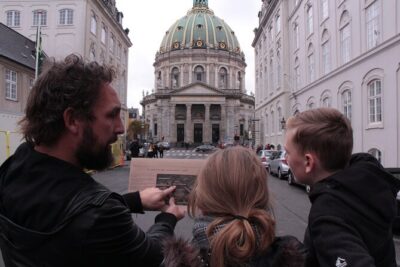
Copenhagen Self-Guided Murder Mystery Tour by Amalienborg Palace
Read our review →Browse the lists this tour appears in