
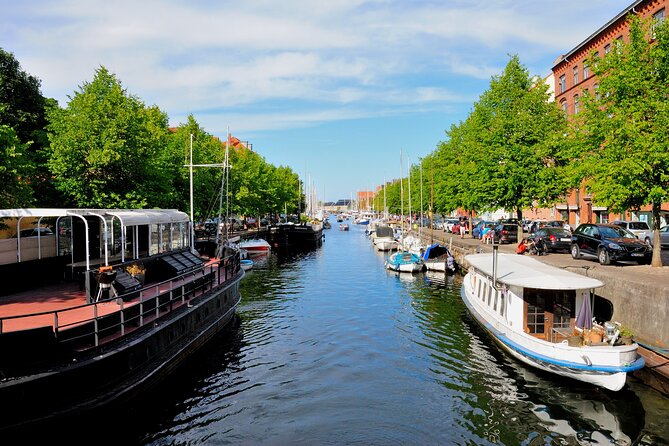
Reviewed · NYHAVN & CHRISTIANSHAVN TOURS
Copenhagen Alternative Private Tour: Vesterbro & Christianshavn
Copenhagen’s postcard center is polished, but this walk takes you into the city’s tougher, stranger, more human quarters. You move from former worker housing and wartime resistance sites in Vesterbro across the harbor to old merchant streets, churches, shipyards, and the self-governed community of Christiania.
I like the way the tour connects small details to big changes. A former moat sits beneath Viktoriagade, a castle-like wall once caught stray bullets near a shooting range, and a humble radio shop helped Danish resistance members hear the BBC during World War II. I also like the private format, which lets you ask questions and shape the pace.
The main drawback is value. At $147.96 per person, this is a serious price for a walking tour, especially if you do not choose the Full Option with the Danish tasting and drink. The route can also be shortened if you have a ship or train to catch, so confirm the full timing at the start.
Key points to know before you book
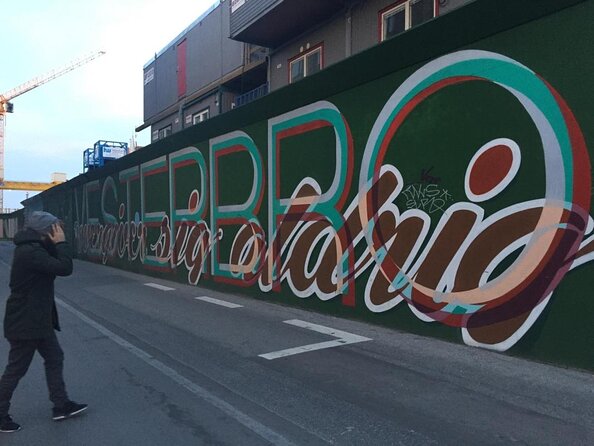
- A private walk through two very different Copenhagen districts: Begin among Vesterbro’s working-class streets and finish in the old port quarter of Christianshavn.
- Resistance history on Istedgade: See the former Stjerne Radio at Istedgade 31, where BBC broadcasts were transmitted during the German occupation.
- The Full Option includes a Danish tasting and drink: Lunch at a classic Danish restaurant is listed as part of the Full Option, not the basic tour.
- Christiania is visited without the guide: Guides are not allowed to accompany you inside, so the final portion is self-guided.
- Most of the route is on foot: Metro tickets are included, but one past outing completed the walk without using them.
- The tour suits curious first-time visitors: It gives you social, industrial, and political context that standard central-city sightseeing often skips.
Viktoriagade reveals the city beneath your feet

The tour starts at Viktoriagade 8, a useful location in Vesterbro for seeing how Copenhagen grew beyond its old fortifications. Christian IV created defenses here around 1600, protected by a moat. By the 1950s, the moat had become an open sewer, and the street was built over it.
That simple fact gives you a quick lesson in city change. What began as military ground later became a residential district, and the land along Viktoriagade was sold in lots from 1856. Several buildings were built for charitable purposes, including housing for officers’ widows.
Numbers 8, 10, and 12 date from the mid-1800s and are protected buildings. I find this a good opening because you are not just looking at attractive facades. You are hearing why the street exists and who the first residents were.
More Nyhavn and Christianshavn walks:
- Hippies & Christianshavn Walking Tour
★ 5.0 · 249 reviews - Private Walking Tour of Christianshavn
★ 5.0 · 122 reviews - Copenhagen: Christiania & Christianshavn Guided Walking Tour
★ 4.7 · 119 reviews
From the New Theater to Værnedamsvej
A short walk brings you to Det Ny Teater, opened in September 1908. It was designed to be a large theater and to create a passage between Gammel Kongevej and what was then called Vesterbro Passage, now part of Vesterbrogade.
The stop is brief, but it helps explain Vesterbro’s shift from an outer working district into a busy urban neighborhood. You then reach Værnedamsvej, a street whose name comes from Werner Dam, an 18th-century beer collector who bought land here and opened a popular beer garden.
The street was also once known as Slagtergaden, or Butchers’ Street, because of the many butchers operating in the area. I like these small commercial stories. They give you something concrete to notice as you walk, rather than asking you to admire streets without context.
Saxogade and the cost of crowded housing
Saxogade brings a more serious side of Vesterbro. In the early 1950s, local residents sent a large protest letter about poor housing conditions. The district had originally attracted factory workers from the countryside, many of whom lived in tiny one-room apartments.
As many as 10 people could sleep in one apartment. The campaign for better housing centered especially on children, who were growing up in cramped conditions. This is one of the places where a private guide can add value, since you can ask how industrial growth affected ordinary families rather than only hearing about grand buildings and famous names.
You should expect the tone to shift here. This is not a tour built only around pretty streets. It deals with poverty, overcrowding, addiction, homelessness, prostitution, and the ways Copenhagen has tried to respond to social problems.
The shooting wall and Istedgade’s hard reputation
Skydemuren is one of the more unusual sights. The castle-like wall between Skydebanehaven and Istedgade was built as a bullet trap. Soldiers at the Royal Danish Army shooting range fired toward the wall, protecting traffic on the newly developed Istedgade from stray projectiles.
The wall also forms the end view of Skydebanegade, a street lined with uniform, heavily decorated houses. It is a fine example of how a practical structure can also shape the look of a neighborhood.
Istedgade itself carries several layers of memory. It was named for the 1850 Battle of Isted during the First Schleswig War. Later, it became known for its connection to the Danish resistance during World War II, as well as for drugs and Scandinavia’s largest red-light district.
The famous local spirit of defiance is important here. During the occupation, Istedgade was seen as a place that would not easily surrender. Your guide can connect that resistance identity with the street’s later social troubles, giving you a more honest picture than a simple before-and-after story.
More Vesterbro afternoons:
- Vesterbro Tour With Beer & Pub Visits – Max 10 People
★ 5.0 · 186 reviews - Copenhagen: Vesterbro Beer & Neighborhood Tour
★ 4.8 · 54 reviews - Copenhagen Craft BeerWalk in Vesterbro
★ 5.0 · 24 reviews - Mikkeller Craft Beer Walk in Vesterbro
★ 5.0 · 13 reviews
Stjerne Radio and the Danish resistance
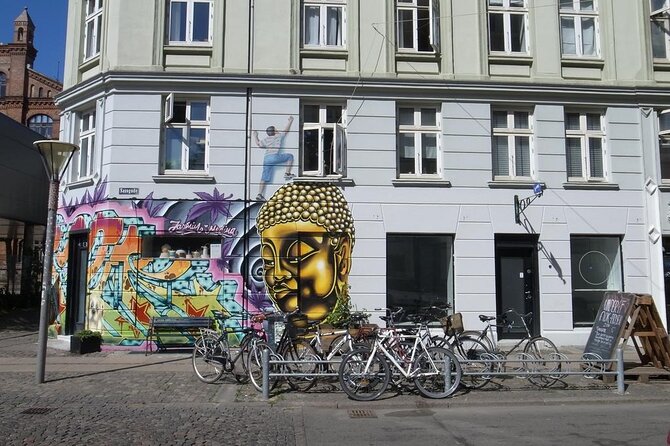
At Istedgade 31, the former Stjerne Radio gives the wartime section a specific address. Carl Munck and J. K. Søndergård opened the shop in September 1942. They soon began transmitting the English BBC broadcast through loudspeakers.
That made the shop a useful part of the Danish resistance. The stop is short, but the point is memorable: resistance did not happen only in secret government rooms or remote forests. A radio shop on a city street could help people hear news that German authorities wanted suppressed.
This is the sort of detail I value in a walking tour. You leave with a place you can identify, not just a broad statement about Copenhagen during the war.
The Meatpacking District, Oksnehallen, and Halmtorvet
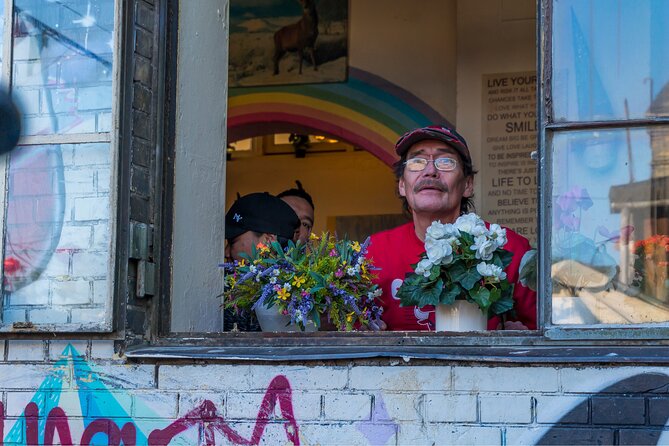
The route continues into Copenhagen’s Meatpacking District, a former industrial area now known for restaurants and nightlife. The change is easy to understand here because the older working buildings remain part of the setting.
Oksnehallen belongs to the Brown District of the Meatpacking area. Built in 1891, it once held merchant offices and had room for 1,600 cattle. The market remained in use until the White Zone opened in the 1950s.
Nearby Halmtorvet recalls Copenhagen’s hay market. The market originally operated inside the Western City Gate at what is now City Hall Square. It closed in 1888 and moved outside the new livestock market, which had opened in 1879. On Wednesdays and Saturdays, several hundred loads of hay and straw could be traded for the city’s horses and cattle.
These stops show how Vesterbro was tied to food, animals, transport, and trade. Today’s dining scene is only the latest layer. If you visit in the evening, you may see the area in its newer role, but this tour gives you the working history beneath it.
Churches and social work on Istedgade
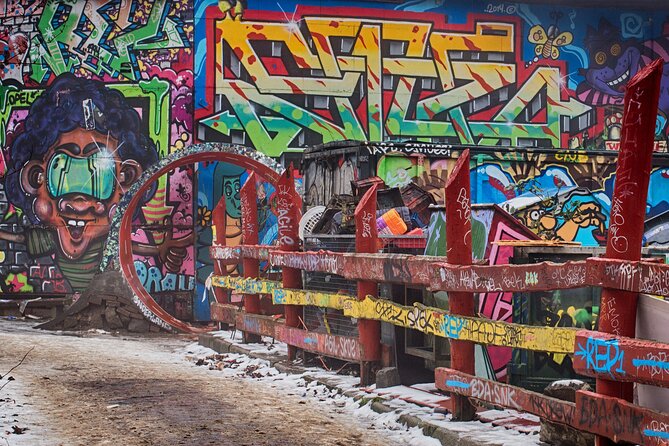
The route pauses at the Men’s Home for homeless people, founded in 1910. It is a private organization supported by the Danish state, designed to help homeless and vulnerable people use their own resources and take part in a diverse society.
At Istedgade 20, Maria Church continues that social role. Opened in 1909, the small church serves homeless people, families in need, and socially marginalized groups. It offers daily spiritual and economic support to people including undocumented immigrants, drug addicts, prostitutes, and others whose lives have been criminalized.
These are brief stops, but they matter. You are not looking at social issues from a safe distance. You are seeing institutions that have been part of the neighborhood for more than a century. Be respectful, keep your voice down, and listen carefully to the guide’s explanation.
Lunch depends on the option you choose
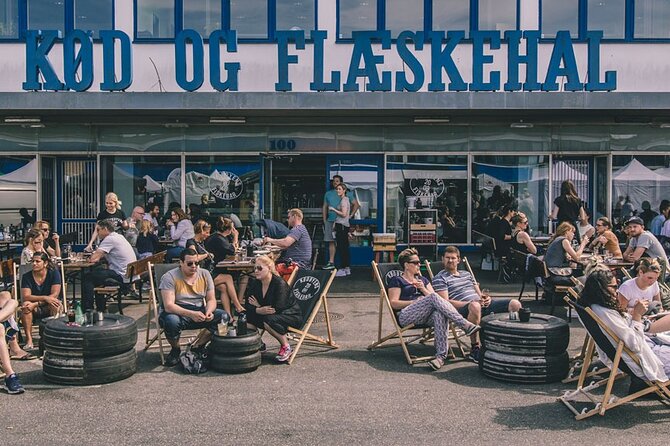
Lunch at a classic Danish restaurant is listed for the Full Option and takes about 45 minutes. A local tasting and a drink are also included only with that option.
This distinction matters because the price can feel very different depending on what you select. One person who joined without the food option expected more of a food tour and found the cost high when no meal or drink appeared. The experience is not designed as a full gastronomic tour. The food component is a supporting stop, not the main event.
If you want the tasting, check that you have selected the Full Option and understand what is included. If you would rather keep moving, the route can focus on the neighborhoods and their stories.
Copenhagen Central Station marks the route’s midpoint
København H, Copenhagen Central Station, was built in 1911 and takes inspiration from the city hall’s architectural style. It is Denmark’s largest railway station by size, with seven platforms and 13 tracks, although Nørreport has the highest daily passenger flow.
The station is a practical landmark as well as an architectural stop. If you are staying near the center or arriving by train, you can easily understand where the first half of the tour leads. It also gives your guide a chance to explain how the old Vesterbro district connects with the rest of the city.
The walking time is substantial. Wear comfortable shoes and expect city streets, cobblestones, and outdoor stops in changing weather. The tour runs in rain, so a waterproof jacket is sensible.
Crossing Knippelsbro into Christianshavn
From the station area, the experience shifts toward the harbor. Knippelsbro is a 115-meter drawbridge linking Copenhagen with Christianshavn. Its name comes from Hans Knip, who operated the bridge and collected tolls from passing ships in 1641. He and his family lived on the bridge.
The bridge is a good transition point. Vesterbro grew through workers, markets, and urban expansion. Christianshavn grew through canals, shipping, warehouses, and trade.
Christians Kirke, built between 1754 and 1759, is a handsome Rococo church. It was originally called Frederik’s German Church and served Copenhagen’s German-speaking congregation. This stop adds a religious and immigrant dimension to the district’s story.
Merchant houses and Copenhagen’s industrial past
On Strandgade, the former DieselHouse location recalls the history of Burmeister and Wain, known as B&W. The company began in 1843 as a one-man smithing workshop and later became one of Denmark’s largest workplaces. Its industrial legacy continued from 1865 to 1979, and the company is now associated with MAN Energy Solutions.
The DieselHouse Museum has moved to Copenhagen’s southern harbor area, so do not expect the old building to function as the museum today. The stop is still useful because Christianshavn’s warehouses and port buildings make more sense once you know how much heavy industry shaped Copenhagen.
Asiatisk Plads was once the base of the Danish Asia Company, which operated from 1732 to 1843. It now houses the Ministry of Foreign Affairs and a convention center. The district’s old shipping wealth remains visible in its scale and buildings.
Sankt Annæ Kirke, Wildersgade, and the old waterfront
Sankt Annæ Kirke leads into some of Christianshavn’s oldest streets. Along the row at numbers 8 to 22 are listed buildings from the 1600s and 1700s, with remains of houses built around 1650. Number 14 is the best-preserved example.
Wildersgade dates from 1617 to 1622, near the founding of Christianshavn. Today it is a quiet cobblestone street with mansions, old homes, and warehouses from the 1700s and 1800s. I like this section because it slows the pace. After the social and industrial stories of Vesterbro, you get old residential streets and water nearby.
The route also reaches a former market square beside the harbor. It is now a pleasant place to pause for water views. Wilders Plads 10 is a particularly interesting building, a two-story timber-framed house built in 1736 as a sailmaker’s workshop and home.
Another yellow Neoclassical building dates from 1754 to 1756. It was first a naval hospice and later housed the Danish Naval Museum, which moved in 2016. These details make it worth looking up from the pavement. Christianshavn is not just canals and picturesque houses. It was a working port with military and commercial uses.
Church of Our Saviour and the old defense ring
Church of Our Saviour is Christianshavn’s best-known landmark on this route. The Baroque church is famous for its twisted spire and outside staircase, which climbs around the tower to the top.
The church remains an active parish church serving about 8,000 people. That point is worth remembering if you visit independently. It is not only a photo stop, and access to the tower is separate from simply seeing the church.
The guide also points out the former defense zone created under Christian IV. It helped complete Copenhagen’s ring of protection and guard the capital against Swedish attack. The fortifications are another reminder that today’s calm streets were once part of a city built for war.
Christiania is the final stop, but the guide cannot enter
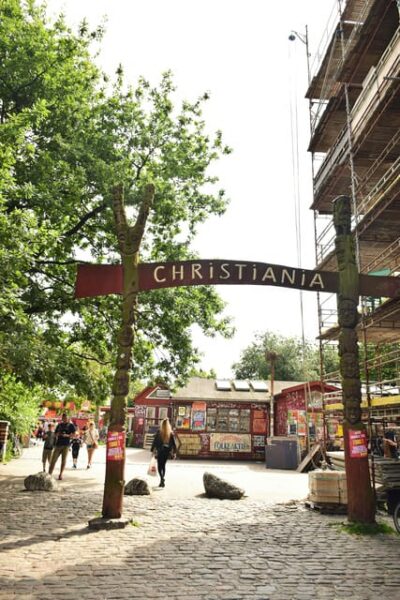
The tour ends at Freetown Christiania, a partly self-governed community created in 1971 by squatters and housing activists on military land abandoned by the Danish army. About 1,000 residents live across roughly 34 hectares.
Christiania is car-free and has become one of Copenhagen’s most visited places. Its origins, community rules, and alternative culture make it unlike the formal streets you have just walked through.
There is one important limitation: the guide is not allowed to accompany you inside Christiania. You reach the entrance with the guide, then explore the area on your own. This is not a minor footnote. If you want detailed interpretation inside the community, this tour will not provide it.
I would treat the final stop as an introduction rather than a guided Christiania visit. You can see the setting, then decide how long you want to remain. Keep in mind that it is a residential community, so act with care and follow local signs and rules.
Timing, price, and who gets good value
The advertised duration is about 3 hours 30 minutes to 4 hours. The route includes many short stops, with about 10 to 15 minutes at the main sites and less time at smaller ones. Lunch adds 45 minutes with the Full Option.
The tour costs $147.96 per person. That is high for a walk, but private guiding changes the calculation. You are paying for a local guide, an English-language experience, metro tickets, and the ability to ask questions without keeping pace with a large group. Guides such as Alessandro, Grazi, and Karolina have led versions of this experience, each bringing a personal approach.
The value is strongest for you if you want social history, wartime stories, architecture, and local context in one outing. It is weaker if you mainly want major sights, museum interiors, or a food-focused experience. The tasting is not included in every option, and most stops are viewed from outside.
Group discounts may reduce the per-person cost for a larger party. The tour is private, so only your group participates. Confirmation is provided at booking, and free cancellation is available up to 24 hours before the start time. The route is near public transportation, service animals are allowed, and most people can participate, though you should be prepared for several hours of walking.
Should you book this Copenhagen walk?
I would book it if you have already seen the central sights and want to understand how Copenhagen’s workers, merchants, churches, industries, and social institutions shaped the city. It is especially useful early in a stay, since the guide can help you get your bearings in Vesterbro and Christianshavn.
Choose the Full Option only if you want the Danish tasting, drink, and restaurant stop. Ask at the beginning how much time remains and confirm whether lunch is part of your booking.
I would skip it if your schedule is tight, your main goal is Christiania itself, or $147.96 feels too steep for an outdoor walking tour. Christiania is only partly guided, and a shortened visit can reduce the value. For a curious visitor who prefers local stories to a checklist of famous sights, though, this private route offers a thoughtful look at Copenhagen beyond the center.
FAQ
How long does the Copenhagen Alternative Private Tour last?
The tour lasts approximately 3 hours 30 minutes to 4 hours. One version was shortened to about 3 hours at the participant’s request because of a cruise schedule.
Where does the tour begin?
The meeting point is Viktoriagade 8, 1620 Copenhagen, Denmark.
Where does the tour end?
The tour ends at Freetown Christiania in Copenhagen Municipality.
Is lunch included?
Lunch at a classic Danish restaurant, along with a local tasting and drink, is included only with the Full Option.
Does the guide enter Christiania?
No. Guides are not allowed to accompany participants inside Christiania, so the final section is explored independently.
Are metro tickets included?
Yes. Metro tickets are included, although the route can sometimes be completed on foot.
Can I cancel for a refund?
Yes. You can cancel at least 24 hours before the experience starts for a full refund. Cancellations or changes made less than 24 hours before the start time are not accepted.
Just added around Copenhagen
- Copenhagen: Express Walk with a Local in 60 minutes★ 4.6 · 3 reviews
- Copenhagen: 3 Hour Extended Grand E-Bike Guided Tour★ 4.6 · 3 reviews
- The Forgotten Giants Private Tour★ 5.0 · 3 reviews
- Castles of Kronborg and Frederiksborg from Copenhagen by Car★ 4.5 · 3 reviews
- Departure by Luxury Vehicule Copenhagen to Copenhagen airport CPH★ 5.0 · 3 reviews
- Copenhagen: Self Guided Scavenger Hunt and Tour★ 4.0 · 3 reviews
- Private Transfer Copenhagen Airport CPH to Copenhagen by Sedan★ 4.5 · 3 reviews
- Copenhagen Craft BeerWalk City Center★ 4.4 · 3 reviews
Nyhavn & Christianshavn Tours, compared.
Christiania & Christianshavn Guided Walking Tour
Read our review →
Private Hippies & Christianshavn Politically Incorrect Tour
Read our review →
Sights & Gems: Medieval Copenhagen & Nyhavn with a local host
Read our review →
Copenhagen Canal Boat Cruise and City, Nyhavn Walking Tour
Read our review →
Copenhagen Christiania: Hidden Stories Self-Guided Adventure
Read our review →
Browse the lists this tour appears in